


Introduction to ESP8266

Introduction to ESP8266
The ESP8266 is a low-cost Wi-Fi system-on-chip (SoC) developed by Espressif Systems. It became widely used in electronics and Internet of Things (IoT) projects because it combines a 2.4 GHz Wi-Fi radio with a 32-bit processor and digital interfaces in a compact device. ESP8266-based modules and development boards make it possible to connect sensors, switches, displays and other electronics to a wireless network without adding a separate Wi-Fi module.
ESP8266 products are commonly used for learning wireless embedded development, building prototypes, connecting devices to local networks and maintaining existing IoT products. The term “ESP8266” may refer to the ESP8266EX chip itself or to a module or development board built around it. These products are related, but they are not identical: a bare chip needs a carefully designed circuit and RF layout, while a module typically includes key supporting parts and an antenna, and a development board adds easier power, programming and prototyping connections.
What Is ESP8266 and How Does It Work?
The ESP8266EX integrates a 32-bit Tensilica L106 processor, Wi-Fi radio and baseband, memory resources, and interfaces such as GPIO, UART, SPI, I²C, PWM and ADC functions. User firmware is generally stored in external flash memory, often integrated into a module. The processor runs the application and manages network communication through the supported software framework.
In a typical IoT application, the ESP8266 reads inputs from sensors or switches, processes the data and sends information over Wi-Fi to a local server, dashboard or cloud service. It can also receive commands over the network and control outputs through suitable driver circuits. The ESP8266 supports station mode, where it joins an existing Wi-Fi network, and SoftAP mode, where it can create its own access point. Some applications use both modes during setup or operation.
Key ESP8266 Features
- 2.4 GHz Wi-Fi: Supports IEEE 802.11 b/g/n networking. It does not provide 5 GHz Wi-Fi.
- 32-bit processor: The ESP8266EX processor can operate at clock speeds up to 160 MHz, depending on configuration.
- GPIO and peripheral interfaces: Interfaces can support digital input/output and communication with external devices. Availability depends on the exact chip/module and pin mapping.
- UART, SPI and I²C support: Commonly used to communicate with sensors, displays, external controllers and other peripherals.
- PWM and ADC capabilities: Useful for simple control and analog measurement, subject to the board design and input limits.
- Compact modules: ESP8266-based modules simplify RF integration and can reduce the effort needed for a wireless prototype.
- Low-power modes: Sleep modes can reduce average consumption in suitable applications, although Wi-Fi transmission can draw high peak current.
- Firmware options: Boards may be programmed using the Arduino core for ESP8266, Espressif SDK options, MicroPython on supported builds, or AT firmware where available.
ESP8266 Chip, Module and Development Board: What Is the Difference?
ESP8266EX chip
ESP8266EX is the integrated circuit itself. A custom design using the chip must account for power supply quality, flash memory, clocking, reset and boot configuration, RF layout and antenna requirements. This is usually intended for designers who are comfortable with wireless hardware design and PCB layout.
ESP8266 modules
Modules such as ESP-12E and ESP-12F combine the ESP8266 chip with supporting components and an antenna arrangement. Modules reduce the amount of RF design work, but designers still need to follow the module datasheet, antenna keep-out guidance, power requirements and certification conditions.
ESP8266 development boards
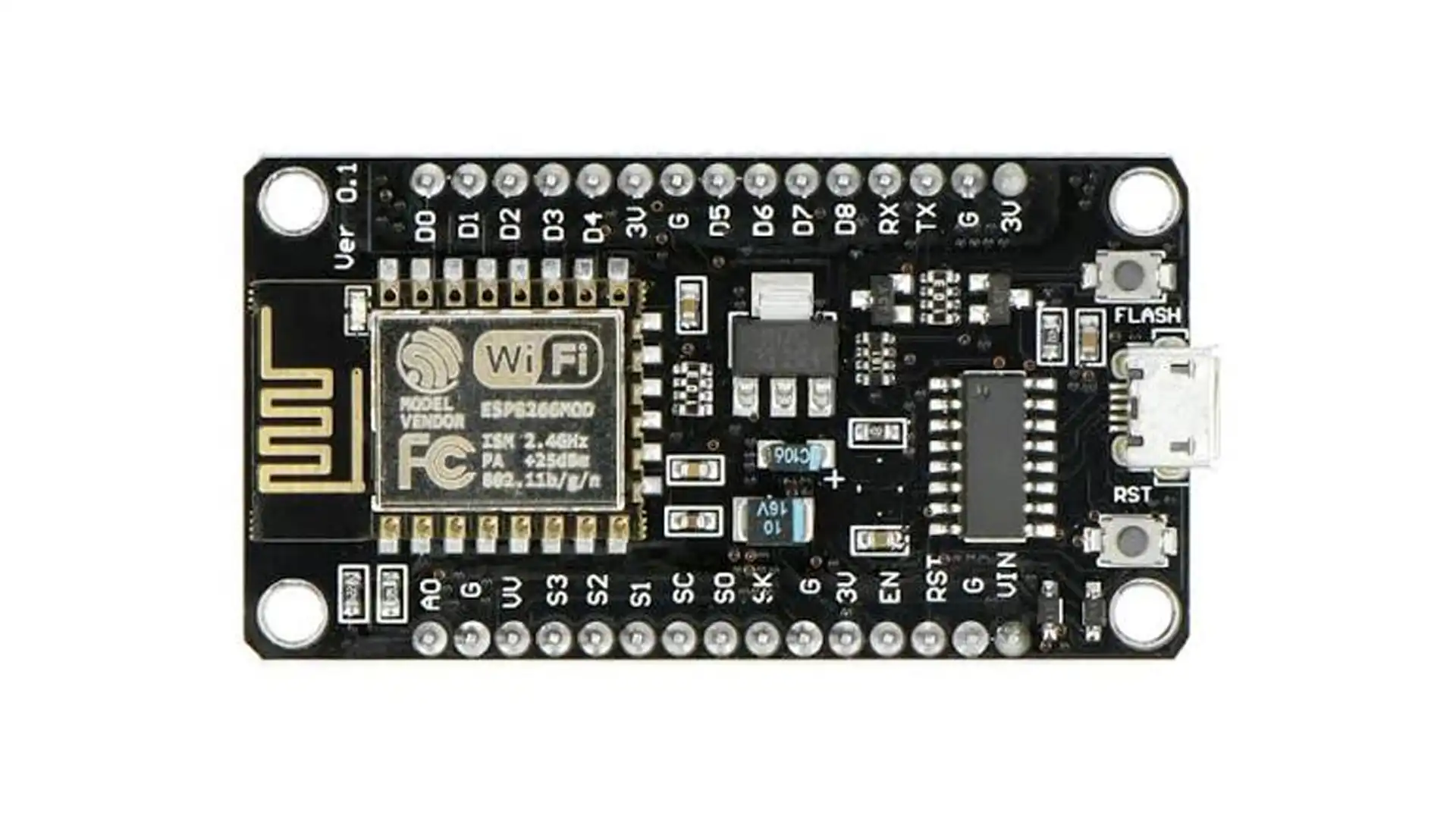
Development boards such as NodeMCU-style boards and D1 mini-style boards make prototyping easier by adding a USB-to-serial interface, voltage regulation and accessible pin headers. Features vary between manufacturers and revisions, so check the exact board documentation rather than relying on the board name alone. Browse [ESP8266 Development Boards] and [NodeMCU Boards] to compare options.
Popular ESP8266-Based Boards and Modules
The ESP8266 ecosystem includes multiple form factors rather than one universal board. Common examples include:
- ESP-12E and ESP-12F modules: Compact modules used in custom PCB designs and embedded wireless products.
- NodeMCU-style development boards: Popular for prototyping, with USB programming and accessible GPIO pins on many versions.
- D1 mini-style boards: Compact development boards often used in small connected devices and maker projects.
- ESP-01 modules: Very small modules suited to some simple Wi-Fi tasks, but with fewer exposed I/O pins and more limitations for general-purpose projects.
Pin availability, flash size, antenna type, regulator capability and USB interface can differ across versions and vendors. Verify the exact product listing and schematic before integrating a board into a design.
Power Supply and Logic-Level Considerations
The ESP8266EX chip operates from a low-voltage supply; the datasheet specifies a supply range of approximately 2.5 V to 3.6 V. Most development boards provide a regulator so that a suitable input supply can be used, but the acceptable input voltage depends on the board. Do not assume that a bare ESP8266 module can be powered directly from 5 V.
The ESP8266 uses 3.3 V logic. Its GPIO pins are not generally 5 V tolerant, so signals from 5 V sensors, controllers or modules may require a suitable level shifter or interface circuit. Wi-Fi transmission can create short current peaks; an undersized regulator, poor USB cable, long supply traces or inadequate local decoupling can cause resets and unstable connections. Follow the hardware design guidance for the exact module and board.
Programming and Development Tools
ESP8266 boards are commonly programmed with the Arduino IDE and the ESP8266 Arduino Core, which provide familiar libraries for Wi-Fi networking, GPIO and common peripherals. Espressif also provides SDK and technical documentation for supported development workflows. Depending on firmware support and the board, users may also encounter MicroPython or AT-command firmware for controlling Wi-Fi functions from another host microcontroller.
Before selecting a toolchain, confirm support for the specific board, library versions and intended network-security requirements. Older tutorials may use outdated libraries, deprecated APIs or insecure network examples, so check maintenance status and current documentation when starting a new project.
Common ESP8266 Applications
- Wi-Fi sensor nodes for temperature, humidity, light or other measurements.
- Smart home prototypes, including wireless switches and status monitors.
- Remote monitoring and data logging over a local network or cloud service.
- Web-based control panels hosted on a small embedded device.
- Wireless interfaces for existing equipment through a suitable UART or other supported interface.
- Connected prototypes for education, maker projects and proof-of-concept development.
- Maintenance and replacement work on existing ESP8266-based products.
For mains-powered appliances, motors or high-current loads, the ESP8266 must not drive the load directly. Use appropriately rated drivers, isolation, protection, enclosure design and qualified review. Wireless connectivity does not replace electrical safety or product compliance requirements.
ESP8266 vs. ESP32: Which Should You Choose?
ESP8266 remains relevant for learning, low-complexity Wi-Fi projects, cost-sensitive prototypes and maintaining existing designs. However, it is an older platform, and Espressif’s current ESP8266EX datasheet marks it as Not Recommended for New Designs. For a new product, compare current ESP32-family devices against the project’s needs.
- Choose an ESP8266-based board when you need a simple 2.4 GHz Wi-Fi design, already have a proven design or library, and the limitations meet the application requirements.
- Consider an ESP32-family device when starting a new design that may benefit from a newer platform, more processing capability, additional peripherals, Bluetooth options or a longer-term product roadmap. Features vary by ESP32 model.
Do not choose by chip family name alone. Compare the exact device’s wireless features, memory, interfaces, power profile, software support, supply availability and lifecycle status.
How to Choose an ESP8266 Board or Module
- Define the task: decide how many GPIO pins and communication interfaces are needed.
- Choose the form factor: use a development board for rapid prototyping, or a module for a compact custom PCB design.
- Check wireless requirements: ESP8266 supports 2.4 GHz Wi-Fi, not 5 GHz Wi-Fi or Bluetooth.
- Verify the power design: check regulator capacity, supply voltage, peak current and decoupling recommendations.
- Confirm pin mapping and boot requirements: some pins have boot-strapping functions or board-specific restrictions.
- Check programming and debug access: ensure the board has a supported USB-to-serial interface or the required external programming adapter.
- Review long-term suitability: for new commercial designs, check product lifecycle guidance and consider a currently recommended alternative.
Frequently Asked Questions
What is ESP8266 used for?
ESP8266 is used to add 2.4 GHz Wi-Fi connectivity to embedded electronics, including IoT sensors, wireless controls, networked prototypes and existing connected products.
Is ESP8266 a microcontroller or a Wi-Fi module?
ESP8266EX is a Wi-Fi system-on-chip with an integrated processor. ESP8266-based modules and development boards package it in forms that are easier to integrate or program.
Does ESP8266 support 5 GHz Wi-Fi?
No. ESP8266 supports 2.4 GHz Wi-Fi using IEEE 802.11 b/g/n.
Can ESP8266 GPIO accept 5 V?
Generally, no. ESP8266 GPIO uses 3.3 V logic and should not be connected directly to 5 V signals unless a suitable interface designed for that purpose is used.
What is the difference between ESP8266 and NodeMCU?
ESP8266 refers to the chip or family of devices. NodeMCU commonly refers to ESP8266-based development boards and also to a firmware ecosystem; exact board features vary by version.
Can ESP8266 connect to sensors?
Yes. It can interface with compatible sensors using GPIO and supported serial interfaces such as I²C, SPI or UART, subject to pin availability and voltage compatibility.
Is ESP8266 suitable for new product designs?
It can still be useful for existing designs and simple prototypes, but Espressif currently marks ESP8266EX as Not Recommended for New Designs. Compare newer alternatives for a new commercial product.
Which programming environment is commonly used?
The Arduino IDE with the ESP8266 Arduino Core is widely used. Other options depend on the firmware, board and application.